Networking Tailscale Zero Trust
Tailscale-Only Ingress Architecture
Comprehensive technical guide detailing the Tailscale-only access model, WireGuard P2P mesh encapsulation, NAT traversal mechanisms, and security policy.
Tailscale Ingress Visual Diagram
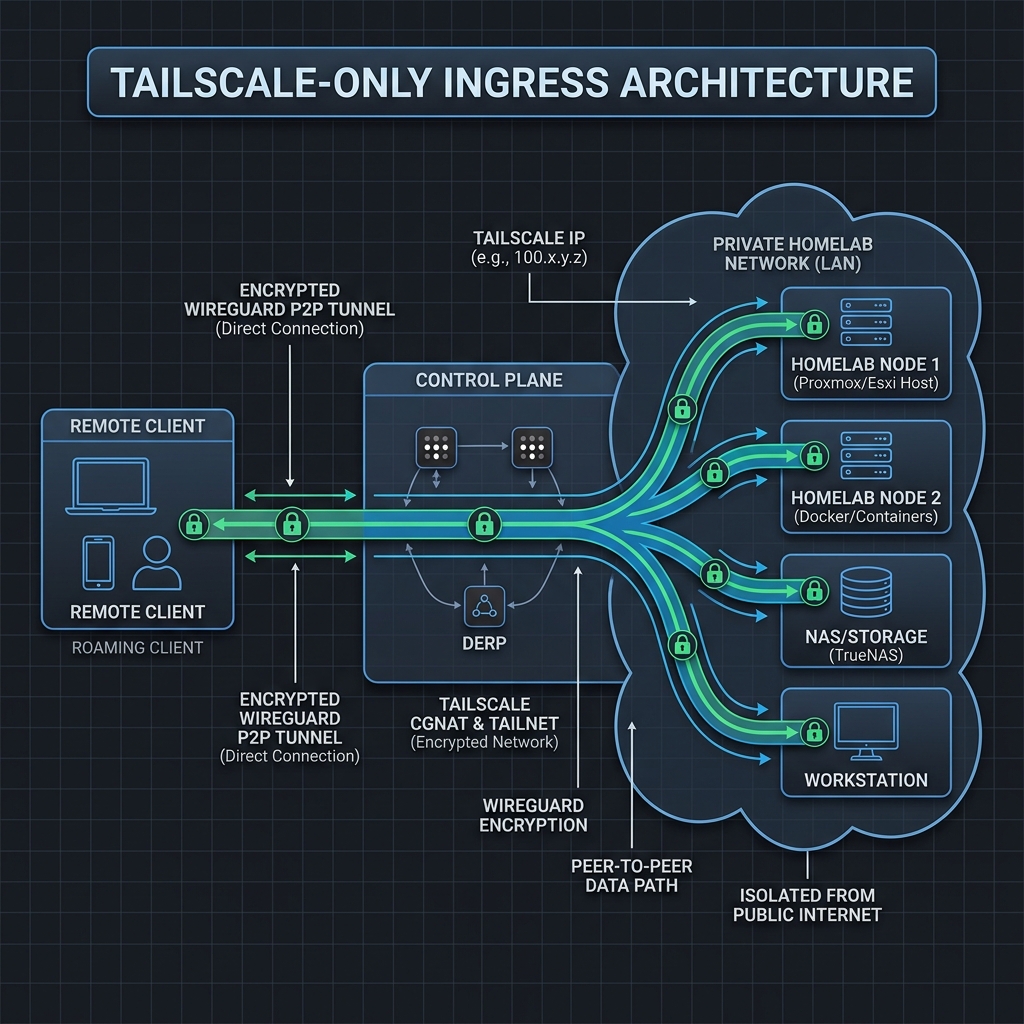
Technical Deep-Dive: How Tailscale Secures Ingress
1. WireGuard Encryption & Key Exchange
Tailscale is built directly on top of the modern WireGuard VPN protocol. Every node in the homelab generates a unique Curve25519 public/private key pair: - Private keys never leave the host node. - Public keys are synchronized through Tailscale's control plane. - Data packets are authenticated and encrypted using ChaCha20-Poly1305.
2. NAT Traversal & DERP Relays
Most home ISPs place connections behind symmetric NAT or Carrier-Grade NAT (CGNAT), preventing traditional incoming VPN connections. Tailscale solves this using STUN (Session Traversal Utilities for NAT) and ICE (Interactive Connectivity Establishment):
- Direct P2P Link: Over 90% of connections establish direct peer-to-peer UDP links between client and homelab nodes over port 41641.
- DERP Relays: If direct UDP communication is blocked by restrictive firewalls, traffic routes through encrypted DERP (Detoured Encrypted Routing Protocol) relay servers. DERP nodes cannot read payload data because traffic remains end-to-end encrypted with host keys.
3. MagicDNS & Split-Horizon Resolution
Tailscale MagicDNS automatically maps node hostnames (server-a.tailnet.ts.net) to private 100.64.0.0/10 overlay IP addresses. Combined with AdGuard Home, all homelab services resolve seamlessly without public DNS records exposing internal IP addresses.
Security Model & Resilience Strategy
Security Failure Mode: Deny-by-Default
If Tailscale connectivity is interrupted or disabled: - Ingress access to all services is intentionally blocked. - No fallback public endpoints exist. - No router ports are opened as emergency backups.
Downtime is treated as a protected security state. Restoring service connectivity requires restoring the Tailscale control link, eliminating the risk of exposure during network maintenance.