Networking Basics Principles
Networking Basics & Core Architectural Principles
This document defines the foundational networking principles, threat modeling assumptions, and traffic rules governing all nodes and services across the homelab infrastructure.
Architectural Principles Visual Diagram
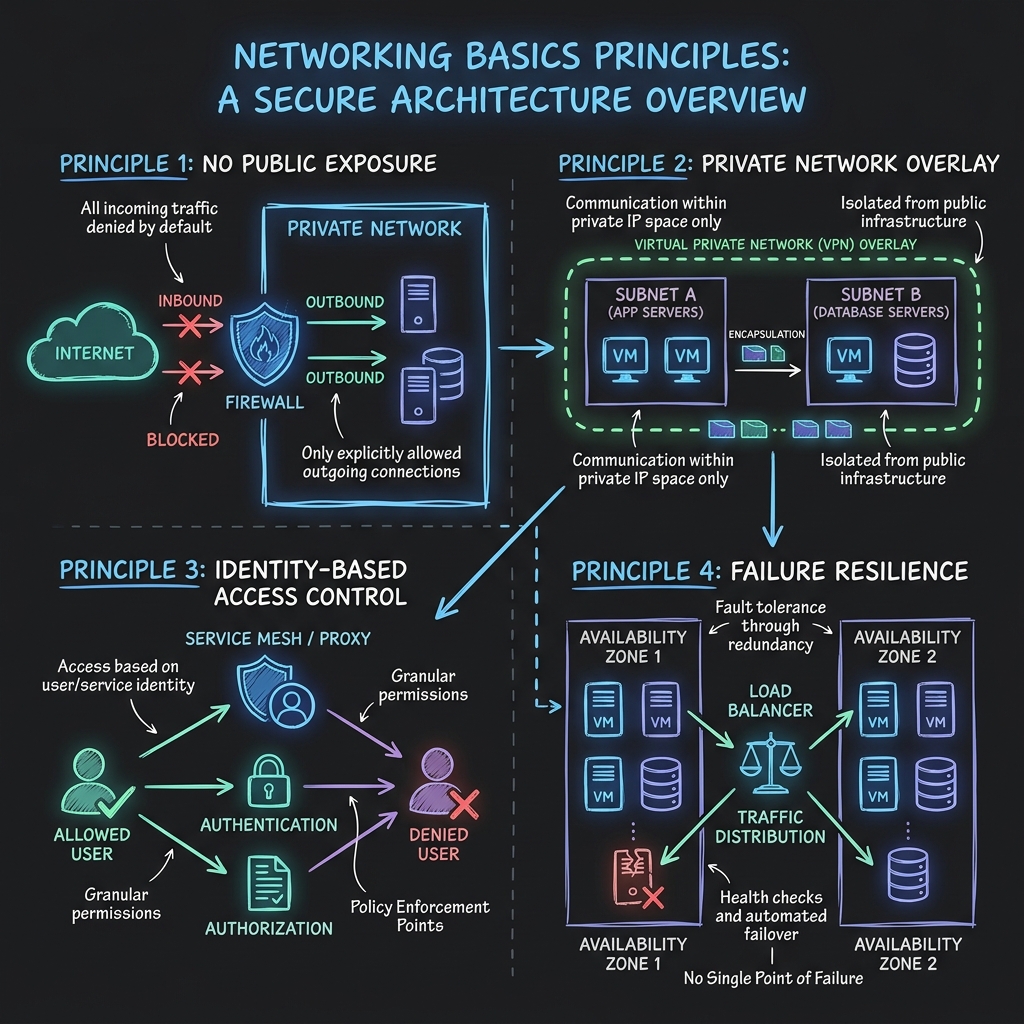
Core Principles Detailed Breakdown
1. No Public Exposure by Default (Default-Deny Ingress)
- Zero Open WAN Ports: The home gateway router operates under a strict
default-denyinbound policy. No TCP/UDP ports (80, 443, 22) are forwarded from the public IP address. - Port Scanner Immunity: By eliminating public listeners, the infrastructure remains invisible to automated Internet-wide port scanners (such as Shodan, Censys, and Masscan).
- CGNAT Compatibility: The network functions independently of ISP-assigned dynamic IPv4 addresses or Carrier-Grade NAT (CGNAT) restrictions.
Public access is treated as an audited exception, never the default operating mode.
2. Private Network First (Overlay Space)
- Carrier-Grade NAT Allocation: All internal communication routes through the
100.64.0.0/10private overlay IP space managed by Tailscale. - Split-Horizon Resolution: Internal domains (
*.lab/*.homelab.net) resolve exclusively inside the private mesh and cannot be queried or resolved by public DNS resolvers. - Interface Binding Scoping: Application microservices bind specifically to private mesh interfaces (
100.x.y.z) or127.0.0.1, preventing accidental exposure to local physical LAN segments.
3. Cryptographic Identity Over Source IP
Traditional network security relies on IP-based firewall rules (allow 192.168.1.50). This architecture replaces location trust with cryptographic identity:
- Device Verification: Every participating host authenticates using public/private key pairs built on the Curve25519 elliptic curve.
- User Authentication: User identity is validated through single sign-on (SSO) providers with mandatory Multi-Factor Authentication (MFA).
- Session Scoping: Network privileges follow the authenticated identity, regardless of whether the device is connected to home Wi-Fi or roaming on cellular data.
4. Failure Resilience & Fault Isolation
Systems are engineered under the assumption that external network paths and overlay links will experience transient failures:
- State Offline Operation: Internal nodes continue processing local tasks (e.g., ZFS snapshots, local media streaming) even if external internet uplink drops.
- Data Persistence Scoping: Persistent application state is isolated in
/srvand mounted ZFS pools, ensuring that OS reinstallation or network reconfiguration never corrupts database volumes.
Traffic Flow Architecture
flowchart LR
subgraph Clients [Authenticated Client Layer]
Laptop[Workstation / macOS]
Mobile[Mobile Device / iOS]
end
subgraph Overlay [Encrypted Overlay Layer]
Tailnet[Tailscale WireGuard Mesh 100.64.0.0/10]
end
subgraph Homelab [Homelab Infrastructure Layer]
NPM[Nginx Proxy Manager :443]
Immich[Immich Photos Container]
Jellyfin[Jellyfin Media Container]
AdGuard[AdGuard Home DNS]
end
Laptop -->|WireGuard Tunnel| Tailnet
Mobile -->|WireGuard Tunnel| Tailnet
Tailnet --> NPM
NPM -->|Internal Forwarding| Immich
NPM -->|Internal Forwarding| Jellyfin
Tailnet -->|DNS Query :53| AdGuard